
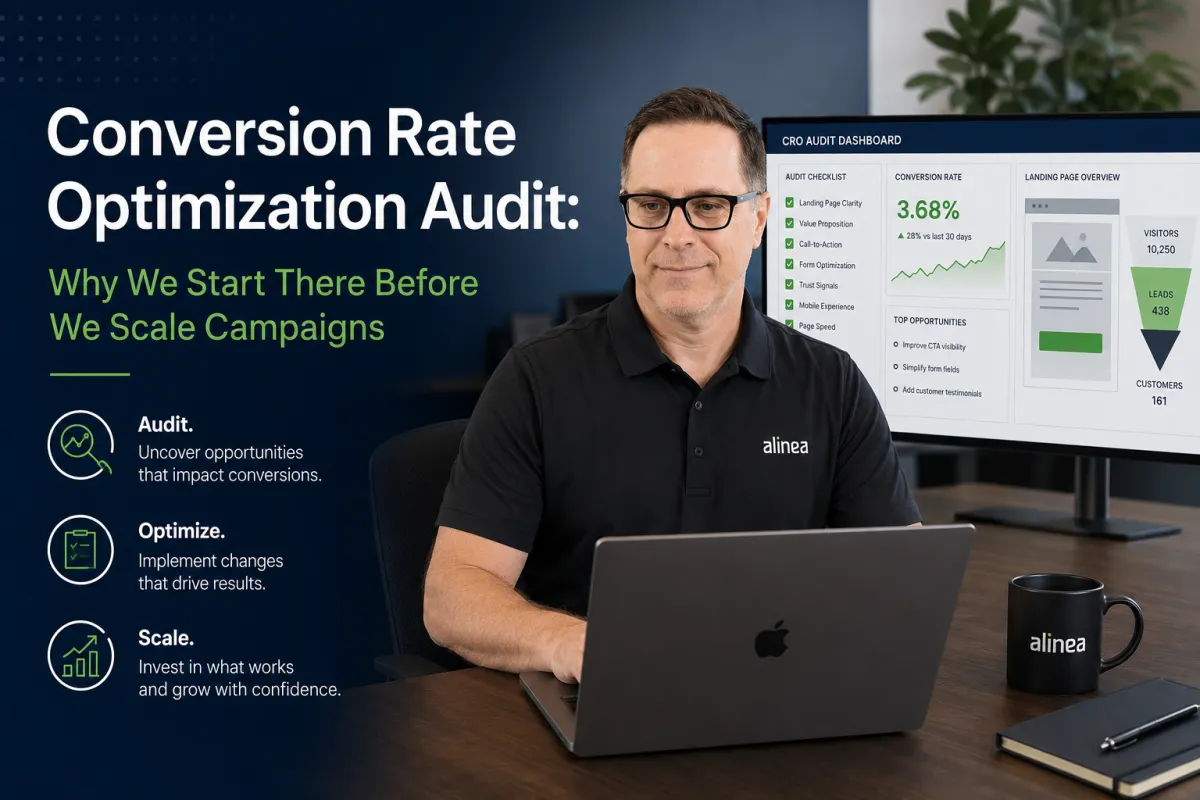
Conversion Rate Optimization Audit: Why We Start There Before We Scale Campaigns
A lot of businesses want to talk about campaigns first.
We get it. Traffic feels exciting. New ads feel like progress. More clicks feel like movement. The problem is that traffic only gets more expensive when the website behind it is still weak at converting the people you are paying to bring in.
That is why we lead with CRO.
Conversion rate optimization is exactly what it sounds like. It is the work of making the website better at turning visitors into buyers, leads, or booked calls. We look at the site the same way we would look at a salesperson. If that salesperson is weak, every dollar you spend getting someone in the door becomes less valuable. If that salesperson is strong, the exact same traffic gets more productive.
That is the business case for starting with a conversion audit before we talk about scaling media more aggressively.
Why we start with CRO before we push harder on campaigns
When someone comes to us for campaigns, we do not want to guess about the website. We want to know whether the site is helping the media spend or quietly wasting it.
Google’s own guidance on landing page experience is helpful here because it connects ad performance to what happens after the click. Google looks at whether the information on the page is useful and relevant, whether the page is easy to navigate, and whether the landing page matches what the ad led the user to expect. Google Merchant Center says something similar in its landing page requirements: when the page does not match the promise, users are more likely to leave without buying.
That is why we think starting with CRO is just common sense.
If the page is slow, unclear, hard to trust, or poorly structured, spending more on campaigns usually means paying more to expose the same friction to a bigger audience.
What a CRO audit is actually supposed to do
A lot of people hear “audit” and think of a giant PDF full of observations they cannot act on.
That is not how we look at it.
A good CRO audit should help the business see the first few things most likely to move the needle. Baymard defines a conversion audit as a wide-ranging examination of the customer journey designed to identify UX or technical issues that could be dragging down conversion. Their broader ecommerce CRO research also makes a useful point: better user experience and better conversion are closely connected.
That lines up with how we approach it.
We are looking for the first test we would run, the first friction point we would fix, the first place where the business is losing value between click and action. That might be a weak headline, unclear product information, a trust gap, a clumsy form, bad hierarchy, poor mobile usability, or a page that loads too slowly to hold attention.
The point is not to overwhelm the client with every possible idea. The point is to give them the clearest next move.
Why we give away the first test
This part matters.
When we do a free audit, we try to give as much value in that first pass as we reasonably can. We do not hold back the first useful idea because we are worried someone might take it and run the test themselves.
That is what the audit is for.
We would rather help someone improve their business than play a game where every useful insight stays hidden until a contract is signed. In practice, most serious businesses still want help implementing the work correctly, prioritizing the sequence, and tying those changes back to campaigns, offers, and reporting. Giving someone one strong test idea does not remove the need for strategy. It usually makes the strategy clearer.
That also fits the kind of buyer we want. They are not looking for fluff. They want to know whether the person on the other side of the table can see the problem quickly and explain it in a way that makes sense.
What we usually look at first in the audit
We are usually trying to answer a few simple questions.
Does the page clearly match the intent behind the traffic?
Does it make the offer easy to understand?
Does it reduce hesitation quickly enough?
Does it move the user toward the next action without extra friction?
Does it load well enough to give the page a fair chance?
That last point matters more than most people think. Google’s PageSpeed Insights and Chrome UX guidance are useful because they show both lab and real-user performance data. If a page is slow, unstable, or clunky on mobile, the business is paying to send people into a weaker experience.
We also look at the page like a buyer would. Is the proof strong enough? Is the structure helping the user make a decision? Are important details buried? Is there a clear reason to trust the offer now instead of “thinking about it later”?
Those are the questions that usually lead to the first real test.
Why this matters more for the audience we actually want
The buyers we want most are usually already spending money somewhere.
They may be running Google Ads. They may have traffic from organic search, social, or email. They may even have a decent-looking site already. Their problem usually is not a total lack of activity. It is that the activity is not compounding the way it should.
That is why this conversation lands so well with operators who are already in motion. They know enough to know the funnel feels weaker than it should. They have seen the dashboard. They have read the advice. They have tried a few things. What they want now is a more precise answer to where the leak is.
That is also why we care about giving them the first useful insight fast. The businesses we work best with do not need a basic marketing lecture. They need someone to help them see what to fix first.
If that sounds like where you are right now, our free guide and training is the best place to start. It lays out the system we use to think about traffic, conversion, and the work that makes every channel more efficient.
CRO makes every channel stronger
One of the reasons we like starting here is that CRO improves more than one line item.
If the site converts better, paid traffic gets more efficient.
If the site converts better, email and SMS send traffic into a stronger experience.
If the site converts better, organic traffic becomes more valuable.
If the site converts better, the business gets more leverage out of the same attention.
That is why we do not think of CRO as a side discipline. It is one of the clearest multipliers in the system.
Baymard’s checkout research is useful here too. Their work suggests that the average large ecommerce site can improve conversion significantly through better checkout UX, and their broader checkout usability research keeps reinforcing the same point: a lot of lost revenue comes from solvable friction, not from a lack of demand. You can see that in their checkout usability research and their checkout flow UX guide.
That is why we start where we start.
What happens after the audit
Once we know the first test, the next question is sequencing.
Sometimes the answer is to fix the page before we touch the campaigns. Sometimes it makes sense to improve the page and refine the media at the same time. Sometimes the first test is small enough to launch quickly while the account keeps running. The decision depends on how much friction we see and how expensive the current traffic is.
What we do not like is continuing to scale blindly while pretending the page is “good enough” because it technically exists.
That is usually where wasted spend hides.
What to do next
If you are already paying for traffic and you have a feeling the site is weaker than it should be, the smartest move is usually to look at the page before you ask the campaigns to carry more weight.
Start with the basic question: if your website were your salesperson, would you trust it with a bigger budget right now?
If the answer feels unclear, that is usually the sign.
And if you want us to look at that with you, book a call with us.
