
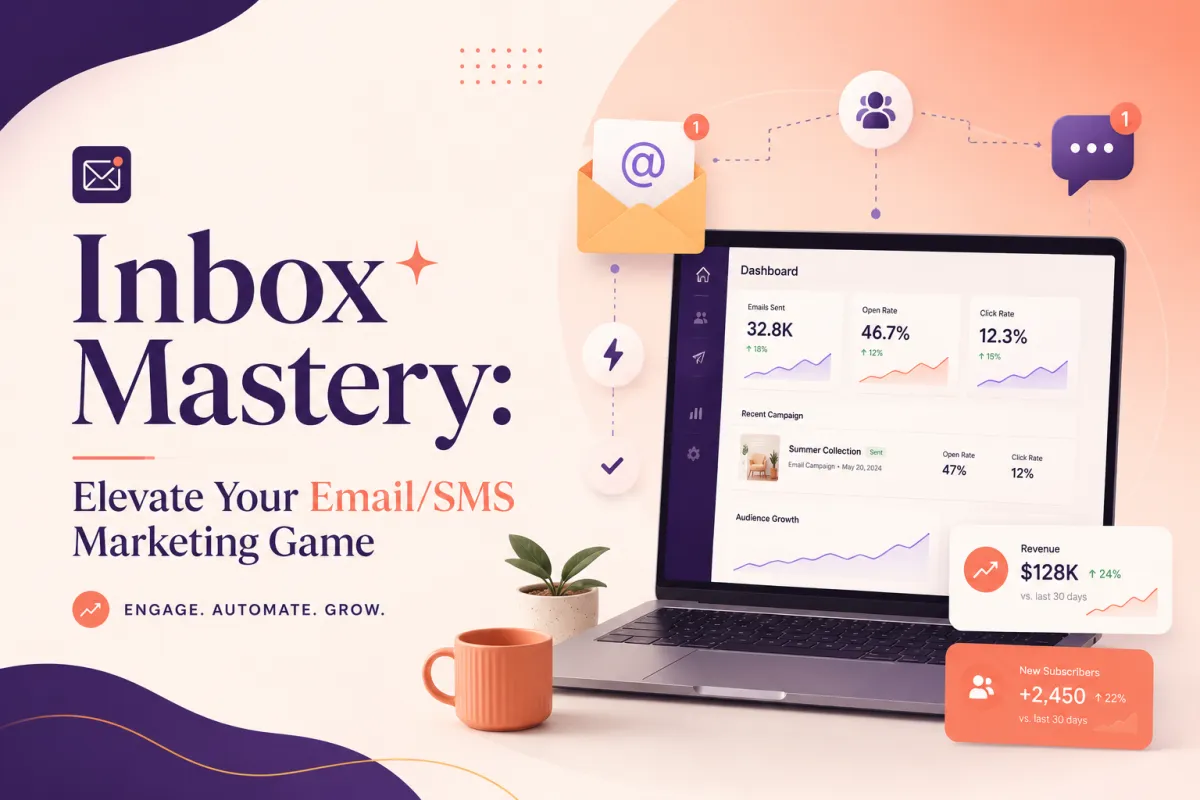
Email and SMS Marketing Strategy: What Actually Drives Revenue After the First Purchase
A lot of businesses treat email and SMS like cleanup work. They spend most of their time on ads, content, and traffic, then circle back to retention when there is finally a little room. We see the same pattern over and over. The store gets visitors, some of them buy, and the business still feels like growth is heavier than it should be because the follow-up system was never built to carry its part of the load.
That is why we think email and SMS deserve a more serious place in the growth conversation. This is not just another channel to add to the stack. It is one of the few places where you can speak directly to people who already raised their hand, already visited the store, or already bought from you once. When that system is weak, the business keeps paying to reacquire attention it could have kept.
If you want the bigger framework we use to think about growth systems like this, our free guide and training is the best place to start.
Start with the real distinction: flows do one job, campaigns do another
The old version of this blog spent a lot of time defining flows and campaigns, which was directionally useful, but it stopped before the part that actually matters.
Flows are the infrastructure. Campaigns are the rhythm.
A flow is what happens automatically when customer behavior triggers a response. Someone joins the list, leaves checkout, makes a purchase, goes quiet for too long, or crosses into a different segment. The system should respond without needing the team to remember to send something. A campaign is different. It is a deliberate send built around a promotion, a product, a launch, a story, or a reason to show up in the inbox that week.
That distinction matters because a business can send plenty of campaigns and still have a weak retention system if the flows are underbuilt. It can also build nice-looking flows and still leave money on the table if the campaign calendar never gives people a reason to come back.
You need both. They just do different jobs.
Why flows deserve more attention than most brands give them
If we were walking into an account that felt underdeveloped, we would usually look at the flows first.
There is a practical reason for that. According to Klaviyo’s 2026 email benchmarks, flows generated nearly 41% of total email revenue from only 5.3% of sends. Their flow-type benchmarks also break out how different flow types perform by revenue per recipient, which is useful because it reinforces something we see in real stores all the time: automated messages usually do a lot more revenue work than the average business realizes.
That is why we do not like treating flows like a backend housekeeping project. They are often the first place to look if the store has traffic, some orders, and far less repeat revenue than it should.
The flows we would build first
Most businesses do not need ten flows at once. They need the right few in the right order.
1. Welcome flow
The welcome flow matters because it shapes the first impression after someone gives you permission to stay in touch. If the only thing they get is a discount and silence, you trained them to expect offers without building any real brand or product understanding.
A stronger welcome flow introduces the offer, the brand logic, the product difference, and the next step. It should move someone from casual interest to a more informed buyer instead of feeling like a coupon stapled to an email list.
2. Abandoned checkout or abandoned cart recovery
This is usually one of the fastest places to recover revenue the store already earned the right to pursue. Shopify’s abandoned checkout automation and recovery settings make it clear that the platform expects merchants to automate this stage. Klaviyo’s abandoned cart benchmark report also shows how strong this flow can be relative to others.
For us, the point is not just to “remind” the customer. It is to reduce the hesitation that kept them from finishing in the first place. Sometimes that means clarity. Sometimes it means reassurance. Sometimes it means a better product angle or a cleaner incentive. The reminder is the vehicle. The message still has to do real work.
3. Post-purchase flow
This is one of the most underused parts of the system. A lot of brands think the sale is the end of the story. It is usually the beginning of the next one.
A good post-purchase flow helps the customer get value from what they bought, reduces buyer’s remorse, sets up review or referral moments, and gives the business a more natural path into the next purchase. This is especially important for subscription brands, wellness brands, or product categories where trust and routine matter over time.
4. Win-back or re-engagement flow
A quiet customer is still data. If someone bought before or engaged before and then disappeared, the business should have a plan for how to bring them back without sounding desperate or generic.
A weak win-back email just says “we miss you.” A stronger one gives the customer a reason to care again. It reconnects to the product outcome, reminds them what made the brand useful in the first place, or gives them a reason to re-enter the conversation.
Where SMS fits and where it can go wrong
SMS can be a strong channel, but it gets misused quickly when the brand treats it like faster email.
People are more protective of their texts than their inbox. That is why the bar is higher. The message has to be more relevant, more concise, and more respectful of timing. It also has to be compliant. The FCC’s small entity compliance guide says businesses need prior express invitation or permission before sending marketing texts, and the FCC’s 2024 order clarifies that revocation of consent can be made in any reasonable manner and must be honored promptly. That should shape how you build the channel from the start.
We think SMS works best when it is used with intention. Launch reminders, cart recovery, time-sensitive messages, and high-signal moments usually make more sense than blasting the same generic promotion that already went to email.
Segmentation is what keeps the channel from becoming spam
This is one of the biggest value gaps in the old version.
Segmentation is not a nice extra. It is one of the things that separates a real retention system from a noisy send calendar. Shopify’s customer segmentation tools make it easier to create and manage groups based on behavior, and Shopify’s email analytics help you see who opened, clicked, converted, or ignored the send.
That matters because different customers need different messages. A first-time buyer should not hear the same thing as a repeat buyer. A high-value customer should not receive the same cadence as a disengaged subscriber. Someone who bought a replenishable product should enter a different rhythm than someone who bought a one-time gift.
When the business skips segmentation, it usually ends up talking to everyone in the same tone and then wondering why the channel feels weaker than it should.
Campaigns still matter, but they should build on the system
A lot of teams swing too far in one direction. They either rely on flows and barely run campaigns, or they send campaigns constantly because the flows were never set up properly.
We want campaigns to sit on top of the system, not compensate for the absence of one.
That means campaigns should feel intentional. They should support launches, product moments, promotions, storytelling, education, or category demand. They should not exist only because it has been a few days since the last send.
The frequency question is always contextual. It depends on list quality, customer expectation, category, and how good the messaging actually is. A strong brand with clear reasons to email can send more often than a brand that only shows up to ask for money. That is why “how many emails should we send per week” is usually the wrong first question. The better question is whether the audience would have a good reason to care about what is being sent.
What we would actually measure
If this channel is going to matter to the business, it needs a scorecard that goes beyond open rate screenshots.
We would look at contribution to revenue, flow-by-flow performance, segment performance, recovery from abandoned checkout, repeat purchase behavior, and the quality of the list itself. We would also look at campaign behavior alongside flow behavior so we can see whether the sends are working together or stepping on each other.
That part matters for the audience you want most. They are already validating decisions with AI, benchmarking channels, and looking for signs that the operator on the other side understands what actually moves the business. Generic advice does not convert that buyer. Specific methodology does.
What this means for the kind of client we want
The kind of buyer who fits us usually is not asking what email and SMS are. They are trying to figure out why the channel still feels underbuilt after all the guides, templates, and “best practices” they have already read.
Usually the answer is simple. The system was never prioritized correctly.
The business may have traffic and first purchases, but the retention engine is still too shallow. The flows are weak. The messaging sounds broad. SMS is either absent or overused. Segmentation is loose. Reporting is surface-level. The team knows the words, but the machine is still not doing the work.
That is the gap we care about.
What to do next
If your store has email and SMS set up but the channel still feels lighter than it should, we would start by asking a few direct questions. Which flows are live right now, and which ones are actually pulling their weight? Are campaigns adding value or just filling the calendar? Does the list get segmented in a way that changes the message meaningfully? Is SMS being used with enough restraint and enough relevance to stay valuable?
Those questions usually tell the truth quickly.
If you want help sorting through that with us, book a call.
