
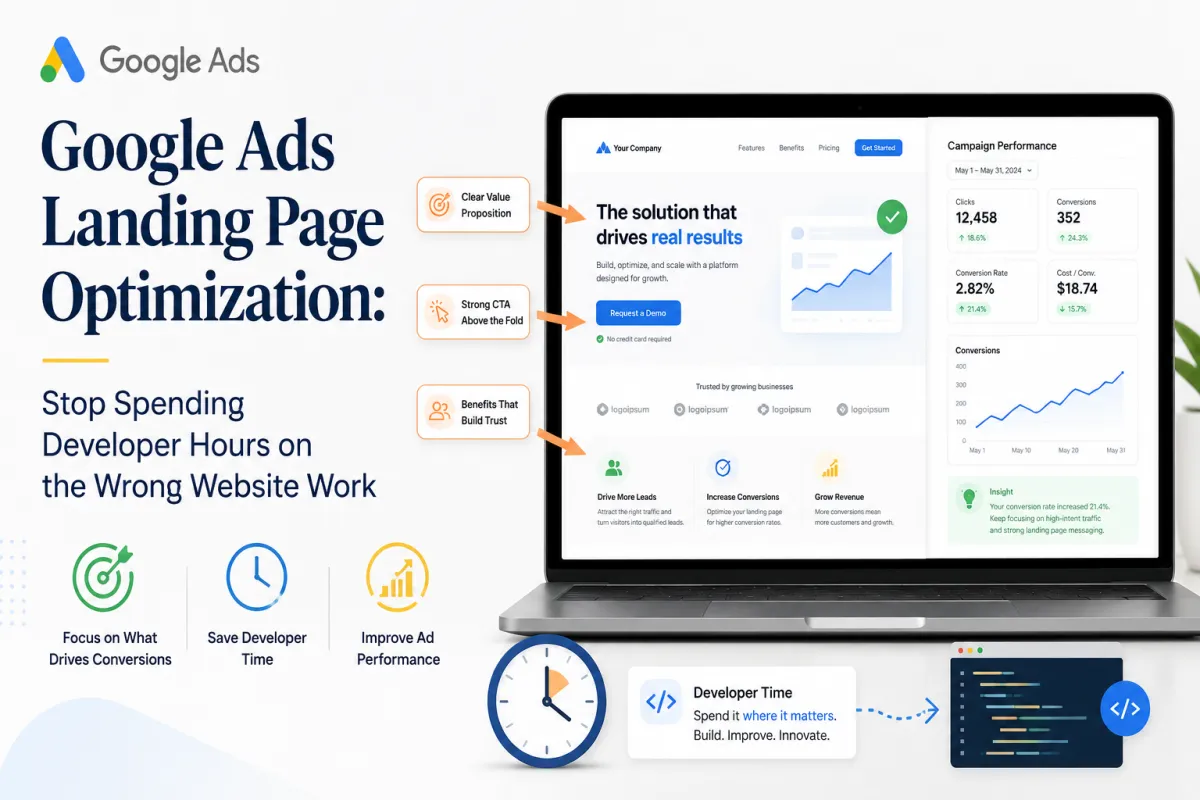
Google Ads Landing Page Optimization: Stop Spending Developer Hours on the Wrong Website Work
A lot of businesses running paid traffic have the same hidden problem. They are paying for web support every month, the bills feel substantial, and a surprising amount of that time is going toward tasks that do very little to improve sales, lead quality, or campaign performance.
That is where this conversation usually needs to get more honest.
We have clients who use us for a lot of development work, and when we send billing, we do not just show the hours. We also point out which tasks their own team could probably handle next time. That is not because we are trying to shrink the relationship. It is because we would rather keep our hours pointed at the work that actually helps the business grow.
If you are already paying for Google Ads, this matters even more. Google’s own guidance on landing page experience makes it clear that the page behind the click affects ad relevance and overall campaign quality. That means every hour your developer spends on low-impact convenience edits is an hour that could have gone toward a better conversion path, a better landing-page experience, or a feature that helps paid traffic produce more revenue.
The hidden cost of small edits
The transcript gets at something most operators already feel but do not always say out loud. Small edits are not free just because they are easy.
A new staff bio on the site, a quick content update, a product-page tweak, or a one-off support request can all feel harmless in isolation. The issue is that they stack. Across the industry, a big chunk of web work still gets consumed by these basic updates. When that happens, the business ends up paying expert rates for tasks that could often be taught internally in one session.
We would rather tell a client that directly than let the retainer drift into convenience work.
That is one reason we like a more transparent billing conversation. If something took time, we show it. If it is something your team could learn, we say that too. And if the work is useful operationally but unlikely to move revenue, we label it honestly so the client can decide whether the convenience is worth the spend.
Why this matters more when you are paying for traffic
If you are spending on Google Ads, your website stops being a brochure and starts acting like part of the media-buying system. That is why landing page experience and Quality Score matter so much. Google is looking at the relationship between the ad, the keyword, and the page the user lands on. If the page is weak, disorganized, slow, or disconnected from the promise in the ad, the campaign pays for it.
That is why we try to keep web work attached to outcomes.
A design tweak that improves clarity on a high-intent landing page can matter. A new section that strengthens trust can matter. A cleaner lead form can matter. A feature that helps users get to the right information faster can matter. A random site edit that only makes the business feel tidier may still be worth doing, but it should not be confused with work that is likely to improve conversion.
That distinction is a big one for small teams. You do not need more activity. You need more of the right activity.
Train your team on the simple stuff
This is where a lot of businesses can save money without losing momentum.
If your team is in Shopify and keeps asking outside support to handle every small content or product update, it is usually worth stepping back and asking whether one training session would solve most of that. Shopify’s roles and permissions system and store permissions are designed so businesses can give internal staff access to the parts of the store they actually need to manage.
That means the developer does not have to become your employee’s full-time support desk for every small change.
We will still jump on Zoom if something needs to be explained properly. We just think it makes more sense to teach your team how to handle the easy work so our time can stay focused on the harder things that actually require specialist judgment.
For most businesses, that is a better cost structure and a better long-term operating model.
Use expert hours where the return is easier to justify
This is the part many businesses need to hear more clearly.
You are not hiring a developer just to write code. You are hiring judgment, prioritization, and execution. That value gets diluted when expert hours are constantly pulled into low-leverage requests.
We think those hours are better used on work like:
improving high-intent landing pages
fixing friction in forms or checkout paths
building conversion-focused site features
improving the page experience behind active ad campaigns
solving technical issues that affect revenue or lead flow
advising on whether a requested change is likely to move a KPI at all
That last part matters more than people expect. There are plenty of website requests that make a business feel more polished but have no clear return. We are fine doing that work if the client understands the tradeoff. What we do not like is pretending every site task is equally tied to growth.
It is more respectful to say, “This may help operations or convenience, but we would not expect it to improve sales,” than to quietly bill for it and let the client assume it was strategic.
Why honest pushback usually keeps clients longer
People sometimes assume this kind of transparency would make clients spend less with us. In practice, it usually does the opposite over time.
Clients stay longer when they trust that we are being objective.
If they believe we are trying to protect their budget, explain tradeoffs clearly, and keep our work tied to outcomes, the relationship gets stronger. Atlassian’s communication guidance makes a similar point at the project level: clear protocols and clear expectations reduce misunderstandings and keep teams aligned. That matters in agency work too.
The goal is not to win every task request. The goal is to become the person who helps the business make better decisions about where technical time should go.
That kind of relationship is much harder to replace than generic execution.
This is where PPC and web should actually meet
A lot of businesses still treat PPC and web as separate conversations. One team runs traffic. Another team touches the website. Then everyone wonders why the results plateau.
We do not think that separation helps much.
If you are paying for Google Ads, the landing page is part of the campaign. The message, the trust signals, the load path, the form friction, the layout, and the clarity all affect what the click is worth. That means web work should be prioritized with campaign outcomes in mind, not just by which internal request came in first.
That is one reason we built our Google PPC audit the way we did. The goal is to help businesses see where the real leaks are between click and conversion, not just whether the ad account is technically running.
And if you want the broader system behind how we think about growth, our free guide and training gives you the bigger picture around what to fix first and why.
What to do next
If your business is already spending on paid traffic and still using high-value developer time for low-value site work, the first move is not adding more complexity. It is getting more honest about what your web spend is actually doing.
Look at your last few months of support requests. Which tasks were truly strategic? Which ones were convenience? Which ones could have been handled internally with one hour of training? Which ones should have been replaced by landing-page, conversion, or feature work tied more directly to sales?
Those answers usually tell the truth pretty quickly.
If you want help figuring out where your PPC and website are working together and where they are quietly wasting budget, book a call with us.
