
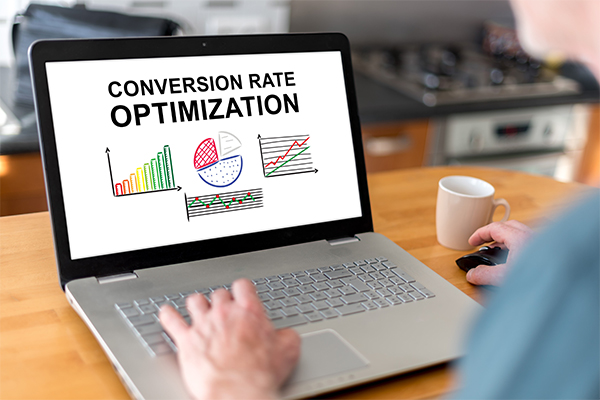
Landing Page A/B Testing: CRO And UTM At Work
When a landing page underperforms, most businesses do the same thing. They start guessing. Someone wants to change the headline. Someone else wants to move the button. Another person thinks the offer is the problem. Before long, the page has been revised three different ways and no one can say with confidence what actually improved results.
That is where landing page A/B testing becomes valuable.
A proper test gives you a controlled way to compare one version of a page against another so you can see how a real audience responds. UTM tracking adds another layer of clarity because it tells you where that visitor came from, which campaign brought them in, and which message or creative influenced the click in the first place. Used together, they give you a much clearer picture of why a page is converting, where it is leaking, and what needs to change next.
For us, this is the real value of conversion work. We are not interested in changing pages just to feel productive. We want to know which inputs are affecting the outcome so the next decision is grounded in something more useful than opinion.
Why landing page A/B testing matters
Traffic is expensive, whether you are paying for it directly through ads or earning it slowly through content, email, or organic reach. Once a visitor lands on the page, that moment matters. If the page creates friction, weakens trust, or makes the next step feel heavier than it should, the cost of that traffic goes up fast.
A/B testing helps us slow that moment down and inspect it properly. Instead of asking whether a page feels better, we can ask whether it performs better. That shift matters because a lot of businesses confuse preference with evidence. They redesign pages around internal feedback, then wonder why conversion rate stays flat.
We would rather learn from behavior.
That means looking at what happens when one page has a clearer headline, a shorter form, a different pricing presentation, a stronger offer stack, or a more direct call to action. The goal is not to test everything at once. The goal is to isolate one meaningful change and see whether it improves the result.
Where UTM tracking fits in
This is the part the older version of the article needed most.
UTM parameters do not run the test. They do not randomly split visitors between page versions. Their job is to help you track where visitors came from and how different campaigns, creatives, and channels are performing once those visitors hit the site. Google’s Analytics documentation still describes UTM parameters as values added to destination URLs so you can identify which campaigns refer traffic, and it specifically notes that utm_content can be used to differentiate creatives or versions within the same campaign.
That distinction matters because it changes how you think about the work.
A/B testing is the controlled experiment. UTM tracking is the attribution layer that helps you read the experiment more intelligently.
If we are testing two landing page versions and traffic is coming from paid social, email, and search, UTMs help us understand whether one source is responding differently than another. That gives us a much more useful read on the results. A page may look average in aggregate while actually performing very well for one audience and very poorly for another. Without clean tracking, that kind of insight gets buried.
How we use A/B testing and UTM tracking together
When we run this well, the process is straightforward.
We start with one clear question. It may be something like whether a shorter headline improves clarity, whether the page needs price upfront, whether a form is asking for too much, or whether trust elements need to appear earlier. Then we build a variant that changes that one variable in a deliberate way.
From there, we make sure the incoming traffic is tagged cleanly so we know which campaign, source, medium, or creative drove the session. This is where UTM discipline matters. Google’s current guidance recommends using a standardized UTM strategy and consistently applying utm_source, utm_medium, and utm_campaign so reporting stays clean and traffic is not fragmented across mismatched naming conventions.
Once the test is live, we are looking at more than clicks.
We want to know whether people are moving deeper into the page, starting checkout, completing forms, increasing average order value, or dropping off at a specific point. We also want to know whether the result holds across the traffic that matters most. A test that improves conversion for low-intent traffic and hurts conversion for high-intent traffic is not a clean win.
That is why this work has to be more thoughtful than swapping buttons and watching sessions.
What to test first on a landing page
Most businesses have more to gain from testing the fundamentals than from chasing clever ideas.
We usually start with the parts of the page that shape clarity and trust the fastest. That often includes the headline, offer framing, product or service explanation, proof placement, pricing presentation, form friction, checkout friction, and call-to-action language.
If a visitor cannot tell what you do, why it matters, or what to do next, the page is already working harder than it should.
That is also why we usually avoid spinning up too many variants too early. The older article suggested that more variants increase your odds of learning faster, but in practice that only helps when you have enough traffic to support it. Most brands do better with fewer, cleaner tests because the results are easier to interpret and the signal is stronger. If you split modest traffic across too many versions, you stretch the data thin and make decision-making slower, not better.
We would rather run a sharper test than a busier one.
A practical example of what this can reveal
One of the more useful lessons from past testing came from a client page where we changed how price was presented. Part of the traffic saw pricing on the page. Another part did not.
What mattered was not the novelty of the test. What mattered was the insight. For that audience, price visibility was not the thing driving hesitation. In fact, the version without upfront pricing led to stronger cart behavior and more completed transactions.
That does not mean every brand should hide pricing. It means assumptions are expensive when they go untested.
This is exactly why testing matters. Teams often spend months protecting a belief that has never been validated. A/B testing forces the market to answer the question instead.
Common mistakes that weaken the results
The biggest mistake is changing too many things at once. If the headline, layout, CTA, imagery, and pricing all change in the same variant, you may get a different result, but you will not know what caused it.
The next mistake is weak tracking discipline. If UTM naming is inconsistent, if campaigns are tagged differently across channels, or if the traffic source is unclear, the reporting becomes harder to trust. That turns what should be a clean read into a guessing game.
We also see businesses call a test too early. A page performs a little better for a short window, and the team decides the answer is obvious. It rarely is. Real testing needs enough data to make the outcome believable, and enough context to understand whether the result is useful for the business, not just interesting on a dashboard.
Why this fits Alinea’s approach
This is where the topic connects directly to Alinea.
Our work is built around clarity, structure, and systems that compound over time. That is the difference between random optimization and meaningful growth. We are not trying to create motion for the sake of motion. We are trying to build a better decision-making environment inside the business so growth becomes easier to diagnose and easier to scale.
That same philosophy runs through why Alinea exists. Businesses rarely get stuck because they lack effort. They get stuck because growth becomes fragmented and no one can say what is actually driving the result.
Testing and tracking help solve that problem. They give you a cleaner path forward.
You can see the same pattern in Alinea’s case study, where progress accelerated once the team stopped guessing, tightened the system, and scaled what had already been proven.
What to do next
If your landing pages are underperforming, the answer is usually not another redesign based on internal preference. It is a better process for learning what your audience responds to and why.
That starts with a cleaner test plan, tighter attribution, and enough patience to read the data honestly.
A/B testing gives you the controlled comparison. UTM tracking gives you the context around the visit. CRO turns both of those into better decisions. When those three pieces work together, the page gets stronger, the traffic gets more valuable, and the business gets clearer on what to fix next.
If you want help diagnosing where your page is losing momentum, book a call with the Alinea team. We can help you identify what to test first and how to build a cleaner path from click to conversion.
FAQ
What is landing page A/B testing?
Landing page A/B testing is the process of comparing two versions of a page to see which one performs better against a defined goal, such as purchases, form submissions, or checkout starts.
What do UTM parameters do?
UTM parameters are tags added to a URL so analytics tools can identify where traffic came from, which campaign drove the visit, and which creative or placement influenced the click. Google Analytics uses them to attribute traffic and campaign performance.
Do UTM parameters create the page split?
No. The split test is created by your testing tool or site logic. UTM parameters help you track and analyze the traffic coming into the test more accurately.
What should we test first on a landing page?
Start with the elements most likely to affect clarity, trust, and decision-making, such as the headline, offer framing, proof, pricing presentation, form length, and call to action.
