
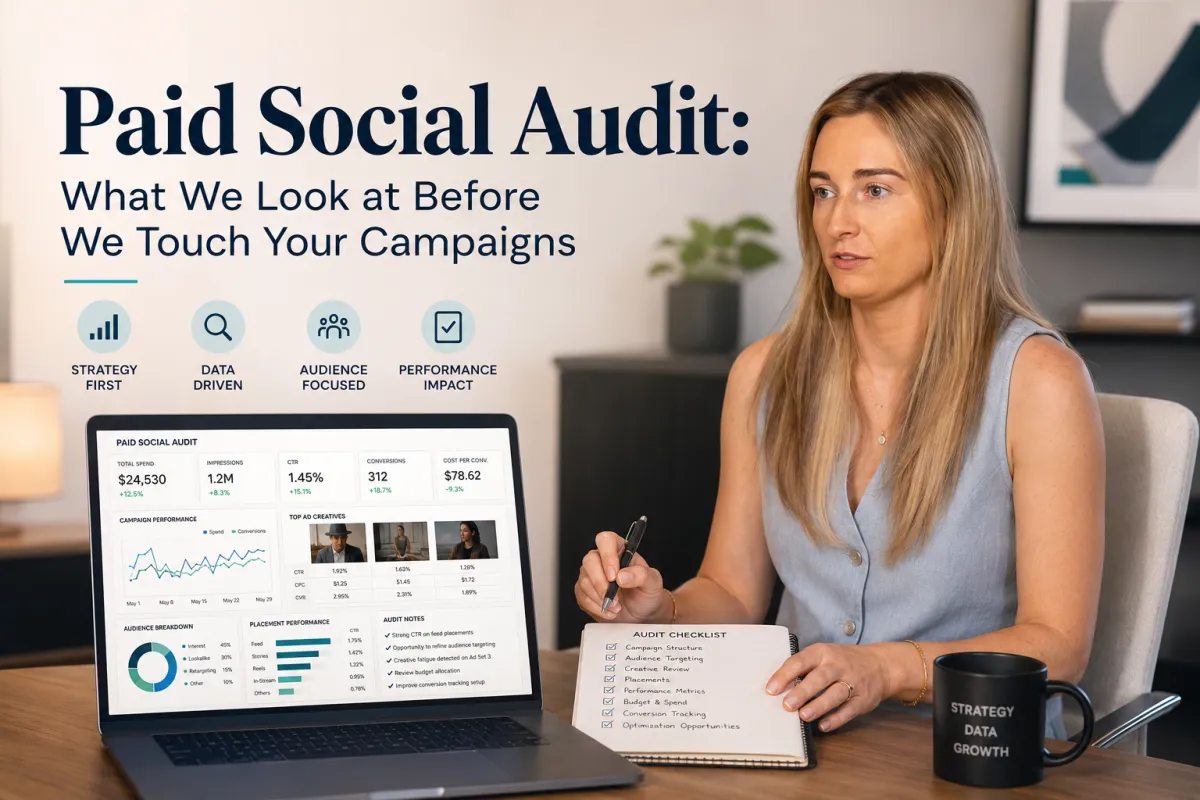
Paid Social Audit: What We Look at Before We Touch Your Campaigns
When someone comes to us for paid social, we are usually not looking at a blank slate. There is almost always history behind the account. Maybe they ran Meta ads before. Maybe they posted every day and felt like nothing happened. Maybe they tried to piece together a strategy from content, past agencies, YouTube, and instinct, and now they are spending money without much clarity on what is actually helping.
That is why we start with an audit.
We do not want to jump into the account, change a few settings, and call it strategy. We want to know what has already been tried, what the business has been saying, what the audience has been seeing, and whether the account is even pointed at the right goal.
That is the part a lot of businesses skip.
We start with what you have already done
The first thing we look at is your prior marketing effort.
If you have run Meta ads before, we want to know what kind of strategy sat behind them. What objective did the campaigns use? What audiences were they built around? How did the creative look? What promise was the ad making, and what happened after the click?
Meta itself structures campaign setup around the objective at the campaign level, because the objective tells the system what kind of result you are actually asking it to pursue. If that starting point was wrong, a lot of the decisions beneath it tend to drift off course too. That is why choosing the right ad objective in Meta Ads Manager matters more than most businesses realize.
We want to understand whether the old setup failed because the business has a market problem, or because the account was solving for the wrong thing from the start.
We usually rebuild because a clean process gives us cleaner data
Once we understand the history, we almost always rebuild the account our way.
That is not about ego. It is about signal.
A lot of ad accounts collect clutter over time. Old campaigns stay live in some form, audiences get layered in without a real reason, objectives shift, placements get constrained, and the account starts reflecting months or years of reaction instead of one clear operating system. A clean rebuild gives us a better read on what is happening now.
Meta’s own guidance on ad quality and best practices for ads delivery reinforces the same idea from a different angle. The platform works best when the campaign has a clear goal, relevant creative, useful landing destinations, and enough room for the system to optimize.
We want to start from that kind of structure, not inherit a pile of half-decisions and hope they eventually work together.
Your organic pages tell us more than people think
One of the most useful parts of paid social onboarding has nothing to do with the ad account. We look at the organic side too.
That matters because your organic presence often reveals the same issues that will hold paid back later. If someone tells us they have been posting every day and nothing is happening, we do not take that as proof that content is useless or that paid is the only answer. We take it as a signal to look closer at the strategy.
Consistency helps. Consistency by itself does not fix weak positioning, weak messaging, or weak creative.
If the page has no clear point of view, if the messaging does not sound like it was built for the niche, or if the creative never earns a pause, posting more often usually just means repeating the same weak signal at a higher volume. That is why we care about what the organic side is telling us before we ever decide how aggressive to be on the paid side.
HubSpot’s current social media strategy guidance still makes a useful point here: a social presence needs a plan tied to goals, audience, and message. We agree with that. The difference is that we are less interested in whether the business has a content calendar and more interested in whether the content actually speaks to the person they want to convert.
Audience fit, message fit, and creative fit all have to line up
This is where most paid social struggles.
Businesses usually think they have an audience problem or a creative problem. Sometimes they do. More often, they have an alignment problem.
The audience is slightly off, so the right message never lands with the right person.
The message is too broad, so even a decent audience sees nothing specific enough to care about.
The creative is flat, so the system never gets enough attention to learn from strong user behavior.
That is why we ask a few direct questions during onboarding.
Are you actually reaching the person you think you are reaching?
Does your messaging sound like it was written for your niche, or could it belong to ten other businesses in the same category?
Does the creative feel sharp enough, personal enough, and clear enough to earn attention in the feed?
Meta’s own guidance around creative text best practices and engaging ad creative supports the same general principle. Short, clear copy matters. Relevant, engaging creative matters. The ad has to help the platform understand who should respond and why.
That is why we do not treat audience, message, and creative like separate departments. They have to work together.
Why “I post every day” is not the win people think it is
We hear this all the time.
Someone says they are consistent, they post every day, and still nothing is happening.
That is a real frustration, especially for the kind of business owner who already feels like they are doing everything they were told to do. The issue is that volume is only useful when it is amplifying a message that already deserves attention.
If the content is generic, if the brand voice is unclear, or if the posts are missing the actual tension the buyer feels, consistency just gives the market more chances to ignore you.
That is one reason this kind of audit matters so much for problem-aware operators. You usually already know you need to be active. What you are trying to figure out now is why the activity is not compounding.
That is exactly the kind of gap we help diagnose.
If you want the broader system behind how we think about that, our free guide and training is the best next step.
Paid and organic should not be telling two different stories
This is another issue we catch early.
Sometimes the organic side sounds one way and the ads sound another. The page feels polished on social, generic in paid, and disconnected on the website. That creates friction the business does not always see because each piece gets made in a different place by a different person with a different goal.
We want the whole thing to read as one coherent brand signal.
The organic pages help us understand how the brand has been showing up. The ad account helps us see what has been paid to scale. The creative and messaging audit tells us whether those two sides are helping each other or quietly fighting each other.
That is also why we care about the landing experience once someone clicks. Meta’s documentation on landing page view optimization makes it clear that the system can optimize toward people more likely to click and fully load the site. That only helps so much if the destination still feels disconnected from the promise in the ad.
Paid social works better when everything after the click still feels like the same conversation.
What we are really trying to find before launch
By the time we finish the audit, we want a clean read on a few things.
What has already been tried.
What was structured correctly and what was not.
Whether the organic presence supports the paid story or weakens it.
Whether the audience, message, and creative are aligned.
Whether the account needs a rebuild or just a refinement.
What the first real test should be once we relaunch.
That gives us a starting point we can trust.
Without that, the campaign becomes another round of guessing, and that is exactly what most operators are tired of by the time they reach out.
What to do next
If your paid social feels heavier than it should, or if you have been consistent on organic and still feel like nothing is clicking, the first move is not posting more and the first move is not launching another campaign with the same assumptions.
The first move is getting clear on what your market has actually been seeing and where the disconnect is.
That is what a good paid social audit should tell you.
If you want help finding that gap, book a call with us.
