
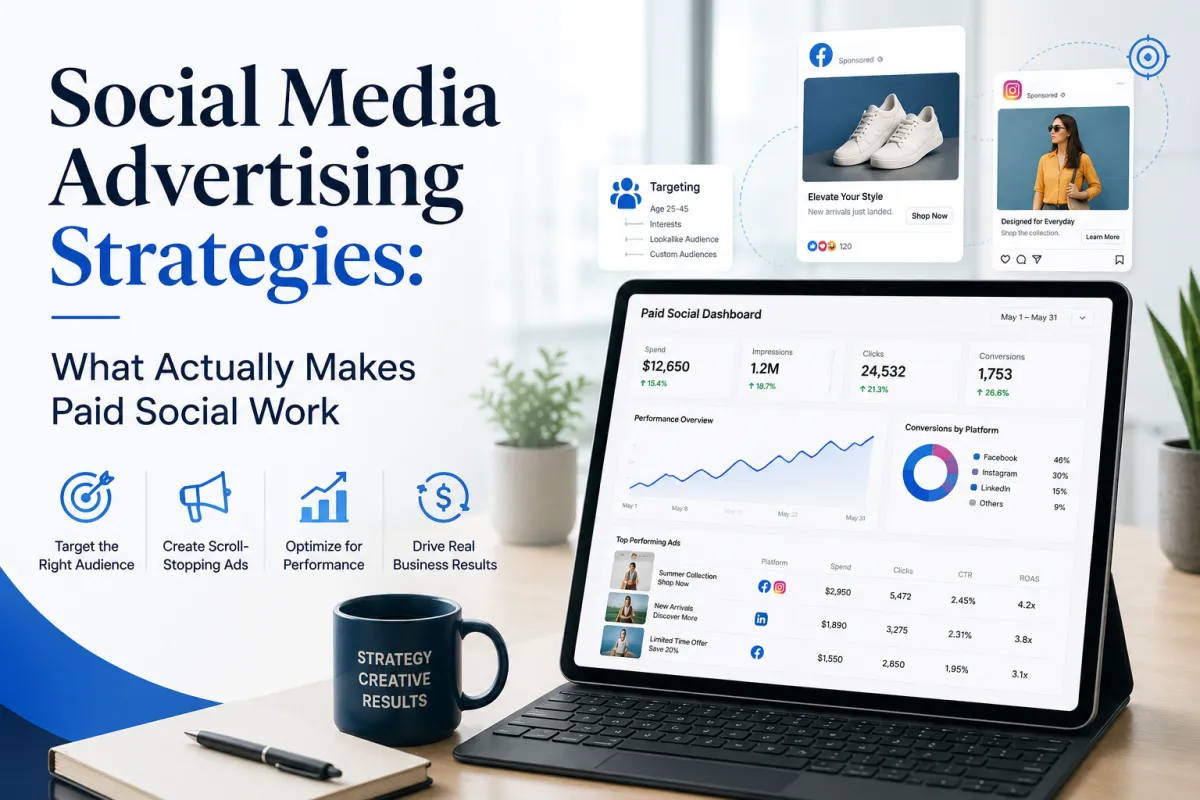
Social Media Advertising Strategies: What Actually Makes Paid Social Work
A lot of businesses treat paid social like a content problem. They think if they can just find a better video, a better image, or a better caption, the campaign will start working. Sometimes that is part of it. More often, the issue is that the ad was never built around how people actually consume content on that platform or how the system is designed to deliver it.
That is where social media advertising strategies start to matter.
Good paid social is rarely about one clever post. It is about creating a campaign where the creative fits the platform, the copy helps the right person understand the offer quickly, the setup gives the system room to optimize, and the team keeps iterating before the campaign goes stale. If you skip those pieces, even strong-looking content can underperform.
Start with platform fit, not just good-looking content
One of the biggest mistakes we see is businesses trying to use one piece of content everywhere and expecting it to work the same way in every feed.
It usually does not.
TikTok’s current creative guidance is very clear on this. Creatives perform best when they are made for TikTok, use vertical 9:16 format, feel more like creator or customer content than polished brand content, and use a strong hook early enough to hold attention. TikTok also recommends showing the core proposition in the first three seconds and prioritizing the hook within the first six seconds.
That matches what we see in practice. Content that feels native tends to outperform content that feels imported. A TikTok ad should not look like a resized Facebook graphic. A Reels ad should not feel like a cut-down webinar clip unless the editing style and message actually support that format. The platform changes how people watch, and that changes what the creative needs to do.
Creative still does the heavy lifting
The old post was right to center creative, but it stopped too early.
Yes, visuals matter. Yes, videos need to earn attention quickly. Yes, the ad has to stand out. The more useful point is that the creative has a job before the rest of the ad ever gets a chance. It has to make the right person pause long enough to understand what the message is about.
Meta’s engagement guidance says creative ads do not require expensive production and recommends using visually interesting, engaging content to improve ad effectiveness. TikTok goes a step further and explicitly recommends featuring real people, leaning into trends where appropriate, and keeping the aesthetic more DIY or native to the platform rather than overly polished.
That matters because a lot of businesses still build ads to look like ads. On some platforms, that can work. On social feeds, especially short-form feeds, that often creates friction too early. The creative has to feel like it belongs in the environment before it can ask for any real attention.
Ad copy should support the creative, not fight it
A lot of weak paid social comes from copy that either overexplains or adds nothing useful.
Meta’s current text guidance recommends keeping primary text short, usually around one to three lines, and making it easy for people to understand what you want them to do at a glance. That does not mean every ad needs tiny copy. It means the message needs to become clear quickly.
We think about copy as reinforcement. The visual should create the stop. The copy should give the stop a direction. It should help the reader understand the problem, the offer, or the next step without making them work too hard. If the creative grabs attention but the copy clouds the message, the click gets weaker. If the creative and copy work together, the ad feels more intentional and the platform has a better shot at finding the people most likely to respond.
That is one reason our paid strategy leans so hard on message clarity and platform fit instead of cleverness for its own sake. If you want the broader framework behind that, our free guide and training walks through the way we think about messaging, offers, and the systems that turn paid traffic into something useful.
Placements matter more than people think
Another gap in the old version was placement strategy.
Meta says using multiple placements can improve ad results because it gives the system more opportunities to deliver the ad to relevant people, and it also allows advertisers to customize creative by placement. That matters because a story placement, a feed placement, and a reels placement do not all ask the creative to do the same job in exactly the same way.
This is where businesses often oversimplify. They either let the same creative run everywhere without thinking about how it renders, or they manually restrict placements too tightly before the campaign has enough data to justify it. Usually, a better approach is to give the system more room, then shape the assets so they still feel deliberate in the placements that matter most.
That is a strategy conversation, not a button-pushing conversation.
Creative fatigue is part of the job
One of the most expensive assumptions in paid social is that a winning ad will stay a winning ad indefinitely.
Platforms keep moving, audiences keep adjusting, and even good creative wears down over time. TikTok’s current guidance recommends checking performance regularly, refreshing creatives when delivery trends decline, and keeping a consistent supply of new creatives available. It also suggests using three to five creatives per ad group and three to five diversified ad groups per campaign when testing. Meta’s delivery guidance makes a similar point by recommending enough placements and variation to give ads the best chance of reaching relevant audiences efficiently.
This is why the old post’s general advice about “ongoing improvement” needed more structure. The practical lesson is that paid social needs a creative refresh rhythm. That does not mean changing things randomly every few days. It means having enough creative variation and testing discipline that the campaign can keep learning instead of leaning too long on one asset until it flattens.
Testing is where strategy becomes real
A lot of businesses say they are testing, but what they are really doing is changing several things at once and hoping something improves.
That is not a testing system.
TikTok’s own creative guidance suggests meaningful creative variation across ad groups, especially when you are still exploring what works. That supports a broader rule we use across platforms: test big differences on purpose, then narrow in once something shows promise.
For us, testing usually means asking a cleaner question. Are we changing the hook, the angle, the offer framing, the creative format, or the CTA? If all of those shift at once, the result is much harder to learn from. If one major variable changes with intention, the next decision gets easier.
That is how paid social becomes less emotional and more useful.
Permissions and asset rights still matter
The old post mentioned getting permission before using content from influencers or social pages, and that point deserves to stay.
If a business wants to use creator content, customer content, or social content that did not originate inside the brand, permission matters. Platform-native ads work best when they feel authentic, but that does not remove the need to use those assets responsibly. TikTok’s business guidance around Spark Ads and creator-led content is a good reminder that authentic-looking content can be a strong ad format, but the asset still needs to be used through the right workflow. Meta also supports creator and partner ad formats that depend on proper access and permissions rather than casual reposting.
That is one of those details that seems small until it creates a bigger problem.
What better social media advertising strategies actually do
At the business level, strong paid social strategies do four things well.
They make the creative feel native to the platform.
They make the message clear quickly.
They give the system enough room to optimize through placements and testing.
They refresh often enough to stay relevant.
That is the bigger shift from the old article. Social media ads are not just about writing shorter copy or keeping videos under a certain length. They are about building a system where platform fit, creative variation, clear messaging, and campaign structure are all working together.
That is also how we think about growth more broadly. Our site is built around helping online businesses move from scattered tactics toward clearer systems and more predictable results, whether that shows up in ads, funnels, site experience, or reporting.
What to do next
If your paid social has felt inconsistent, we would start by looking at the basics in a more honest way. Does the creative actually fit the platform, or does it just exist on the platform? Does the copy make the message easier to understand, or is it filling space? Are your placements helping the campaign scale, or are you constraining them too early? Do you have enough creative variation to test properly and refresh before fatigue sets in?
Those questions usually reveal more than another week of spending with the same setup.
If you want help tightening that system, book a call with us. We can help you sort through what the campaign is doing, where it is getting weaker, and what to adjust first.
